Punjabi kitchens have quietly gone Italian. Somewhere between a Sunday lunch of chole and a Tuesday-night craving for something quick and cheesy, penne pasta has found a permanent spot in the state’s pantries from hostel kitchens in Ludhiana to working-professional homes in Chandigarh to first-time cooks in Amritsar experimenting with red sauce. Search “best Penne Pasta seller in Punjab” on Google, though, and you’ll mostly find generic listicles that never actually explain what separates good pasta from average pasta, or which sellers can be trusted with a repeat order.
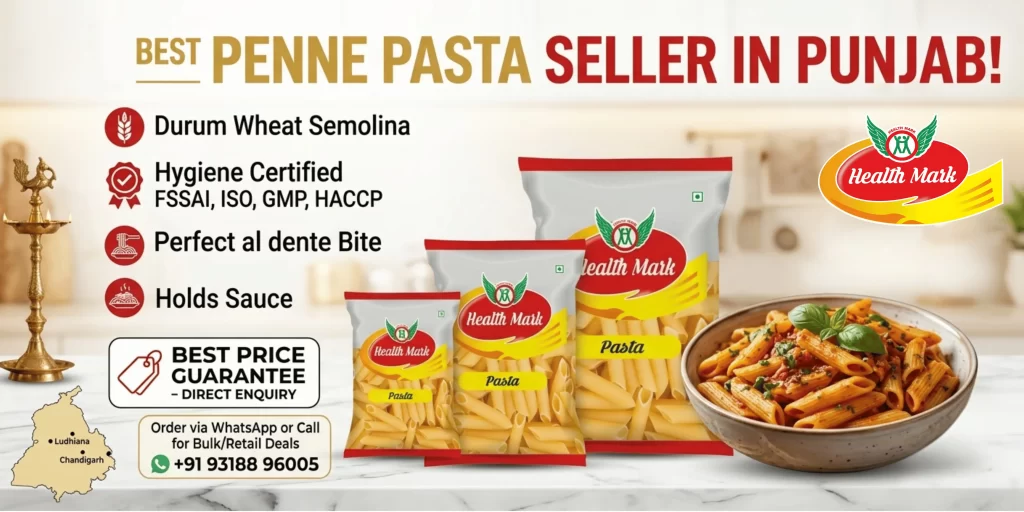
This guide fixes that gap. We’ll cover exactly what makes Penne Pasta genuinely high quality, why the category is growing so fast across Punjab and the wider Tricity region, and why Health Mark an FSSAI, ISO, GMP and HACCP-certified FMCG brand manufacturing out of Baddi and supplying across the Chandigarh–Panchkula–Baddi–Ludhiana belt has become one of the most searched-for Penne Pasta brands in the region. By the end, you’ll know exactly what to check before buying, and exactly how to place an order.
What Actually Makes Penne Pasta “The Best”?
Most buyers judge pasta by the packet photo. That’s the wrong test high quality Penne Pasta is judged after it’s cooked, sauced, and eaten, and by then cheap pasta has already failed. Here is what genuinely separates premium penne from the rest:
Durum wheat semolina, not soft or refined wheat — durum has a firmer gluten structure, which is what gives pasta its characteristic al dente bite instead of turning mushy.
Consistent ridging on the tube (rigate) — the grooves on quality penne exist specifically to trap sauce; flat, overly smooth penne tends to shed sauce off the plate.
Non-sticky texture after cooking — if pasta clumps together minutes after draining, the starch balance in the wheat wasn’t right.
Even cooking time across the pack — every piece should reach al dente around the same minute, so you’re not left with some pieces underdone and others turning to mush.
Hygienic, sealed packaging — moisture ingress is the single biggest reason packaged pasta develops an off smell or invites pests before its printed shelf life is up.
Traceable sourcing and real certification — FSSAI registration is a legal minimum for any food seller in India, but ISO, GMP and HACCP certifications go further and reflect a manufacturer’s actual internal quality-control discipline.
If a seller can’t speak to these six points with confidence, you’re paying for packaging, not pasta quality.
Why Penne Pasta Demand Is Rising Across Punjab
Penne Pasta’s popularity in Punjab isn’t a coincidence it sits at the intersection of a few real shifts in how the state eats:
A growing café and continental-food scene in Chandigarh, Mohali, Ludhiana, Jalandhar and Amritsar has normalised pasta as an everyday dish rather than an “occasion” food.
Cloud kitchens and quick-service restaurants across Punjab’s cities lean heavily on pasta because it’s fast to prepare and travels well for delivery.
Busy working professionals and students in IT hubs like Mohali and Chandigarh want meals that cook in minutes without sacrificing taste penne fits that brief exactly.
Kids and teenagers across Punjabi households increasingly ask for pasta nights, pushing parents to look for trustworthy, good-for-you brands rather than the cheapest packet on the shelf.
Health-conscious buyers are now reading labels more carefully, favouring durum wheat pasta and brands that disclose sourcing over anonymous loose stock.
Health Mark: A Trusted Penne Pasta Seller Across Punjab & the Tricity Region
Health Mark positions itself as an organic-leaning FMCG brand built around purity, transparency and sustainability. According to the brand’s own profile, its products are sourced from certified organic farms that avoid synthetic pesticides, herbicides and GMOs, with an emphasis on tracing each product from farm to consumer shelf.
The company manufactures out of its facility at Plot No. 60, Industrial Township Bhatoli Kalan, Baddi, and its listed service area as shown on its own Google Business listing spans Chandigarh, Panchkula, Baddi and Ludhiana, placing it firmly within reach of Punjab’s biggest cities and the surrounding Tricity market.
Certifications That Actually Matter
Per Health Mark’s Accreditation page, the brand holds the following certifications worth checking for any pasta seller you’re considering:
| Certification | What It Verifies |
| FSSAI | The mandatory Indian food safety license — the legal baseline every packaged food seller must hold. |
| ISO | Standardised, documented quality-management systems applied consistently across manufacturing. |
| GMP (Good Manufacturing Practices) | Hygiene and process controls specifically at the production stage. |
| HACCP | Hazard Analysis & Critical Control Points — a systematic method for identifying food-safety risk points before they become problems. |
Together, these four certifications go beyond the legal minimum and are a reasonable proxy for how seriously a seller treats quality control a genuinely useful filter when you’re comparing the best Penne Pasta seller in Punjab options.
Health Mark Penne Pasta — Product Deep Dive
Health Mark Penne Pasta is described as being made from high-quality durum wheat, engineered for a firm texture and a clean bite. Its tubular, ridged shape is built to hold both creamy white sauces and tomato-based red sauces evenly, and the brand markets it as suited to everything from quick weekday family meals to more deliberate gourmet cooking. The pack is sealed to protect freshness during storage and transit.
Why Choose Health Mark Penne Pasta
• Made from premium-grade durum wheat
• Firm, non-sticky texture once cooked
• Strong sauce absorption for both red-sauce and white-sauce recipes
• Quick and easy to cook for weekday meals
• Hygienically sealed packaging for freshness
How Premium Penne Pasta Is Manufactured
While exact production details vary by manufacturer, reputable Penne Pasta manufacturing generally follows a well-defined sequence, and understanding it helps explain why quality varies so much between sellers:
1. Milling — durum wheat is milled into a coarse, golden semolina rather than fine flour, which is what gives finished pasta its structure.
2. Mixing — semolina is combined with water (and sometimes egg, though most Indian penne is egg-free) into a firm dough.
3. Extrusion — the dough is forced through a die that shapes the ridged, tubular penne form; the die quality directly affects how well the ridges hold sauce later.
4. Cutting — the extruded tubes are cut to a uniform length so cooking time stays consistent across a batch.
5. Controlled drying — pasta is dried slowly at a regulated temperature; rushed drying is a common cause of pasta that cracks or turns powdery in the pack.
6. Cooling and quality checks — dried pasta is cooled and checked for moisture content, colour and shape consistency.
7. Hygienic packing — the pasta is sealed into moisture-proof packaging to protect shelf life and prevent contamination in transit and storage.
Certified manufacturers the kind holding ISO, GMP and HACCP accreditation build documented checkpoints into every one of these stages, which is exactly the difference a home cook eventually tastes in the bowl.
Certified Brands vs. Unbranded Local Sellers — A Straight Comparison
When you’re comparing the best Penne Pasta seller in Punjab, it helps to separate certified, branded manufacturers from unbranded or loose local sellers on the factors that actually affect what lands in your kitchen:
| Factor | Certified Brand (e.g. Health Mark) | Unbranded / Loose Sellers |
| Sourcing transparency | Traceable, disclosed sourcing | Often unclear or undisclosed origin |
| Certifications | FSSAI + ISO + GMP + HACCP | Frequently FSSAI-only or unverifiable |
| Packaging | Sealed, hygienic, moisture-proof | Loose or open sale is common |
| Texture consistency | Controlled extrusion and drying process | Can vary noticeably batch to batch |
| Shelf-life clarity | Printed manufacturing and expiry dates | Often missing or hard to verify |
| Ordering convenience | WhatsApp, phone and enquiry-based ordering, with bulk options | Usually limited to an in-person visit |
Best Penne Pasta Price — What Actually Drives the Cost
Rather than chasing the lowest number on a shelf, it’s worth understanding what actually moves Penne Pasta pricing, so you can judge whether a price is fair:
Wheat quality — genuine durum semolina costs more to source than refined-wheat blends, and that shows up in the price.
Certification and compliance overhead — maintaining ISO, GMP and HACCP standards has a real cost that gets reflected across the product range, not inflated on any single item.
Pack size — smaller trial packs (like a 90 gm pouch) carry a higher per-gram cost than a 450 gm family pack.
Branded vs. loose — sealed, branded pasta will usually sit above unbranded loose stock, largely because of the packaging, testing and traceability built into the price.
Order volume — bulk or wholesale orders typically unlock better per-unit pricing than single-pack retail purchases.
Because pricing can shift with order volume, pack size and season, the fastest way to get an accurate quote for Health Mark Penne Pasta is a direct enquiry rather than relying on a number quoted elsewhere online.
How & Where to Buy Penne Pasta in Punjab
Ordering Health Mark Penne Pasta is straightforward, whether you’re a home cook, a small eatery, or a retailer looking to stock it:
Browse the full range on the Italian product category page to compare penne against elbow pasta and vermicelli.
Check the Penne Pasta product page for pack-size options (90 gm, 180 gm, 450 gm).
Reach out directly for pricing, bulk orders, or retail stocking enquiries by phone or WhatsApp.
Confirm quantity, pack size, and delivery details with the sales team.
Once delivered, store the pack in a cool, dry place, ideally in an airtight container once opened.
Direct contact options for Health Mark:
• Sales: +91 93188 96005 · +91 92185 87660 · +91 98828 96000
• Product Enquiry Page: healthmarkfood.com/product-enquiry
• WhatsApp Enquiry: available directly from the Penne Pasta product page.
Best Way to Cook Penne Pasta at Home
Even premium Penne Pasta can be let down by poor cooking technique. Here’s the method that consistently gets the best texture:
Bring a large pot of water to a full boil use plenty of water so the pasta has room to move.
Salt the water generously before adding the pasta; this is the only real chance to season the pasta itself.
Add the penne and stir once immediately so it doesn’t stick to the bottom.
Cook to al dente (check the pack timing, then taste-test a minute before it’s due) it should have a slight resistance in the centre.
Reserve a small cup of the starchy cooking water before draining; it helps sauces bind to the pasta.
Drain but do not rinse rinsing washes away the starch that helps sauce cling to the ridges.
Toss the pasta directly into the sauce (rather than pouring sauce over plated pasta), adding a splash of the reserved water if the sauce needs loosening.
Serve immediately while the pasta is still hot and the sauce is fully absorbed.
Common Mistakes Buyers & Cooks Make
• Buying loose, unsealed pasta purely because it looks cheaper, without checking sourcing or certification.
• Overcooking past al dente, which leaves penne soft and unable to hold sauce.
• Skipping salt in the boiling water, resulting in bland pasta no sauce can fully rescue.
• Rinsing cooked pasta, which strips away the starch that helps sauce cling to the ridges.
• Ignoring the printed manufacturing and expiry dates, especially on loose or unbranded stock.
• Choosing a seller on price alone, without checking whether they can show real FSSAI, ISO, GMP or HACCP credentials.
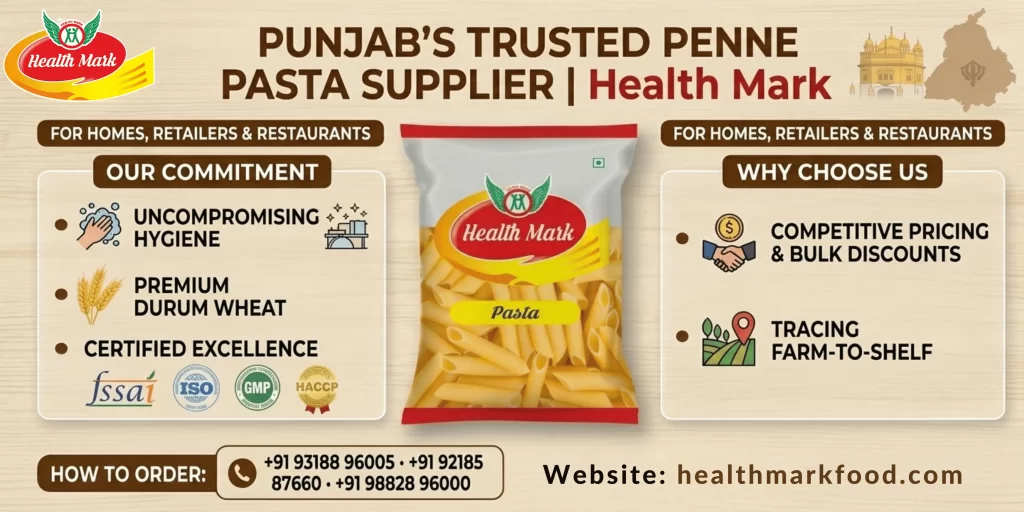
Expert Tips for Choosing & Storing Penne Pasta
• Store unopened packs in a cool, dry pantry away from direct sunlight and moisture.
• Once opened, transfer pasta to an airtight container to protect texture and prevent pests.
• Check the FSSAI license number printed on the pack before buying, especially from a new seller.
• Buy a trial pack size first (like a 90 gm pouch) before committing to a bulk order from a new brand.
• Look at the pasta itself before cooking consistent colour and visible ridging are good signs of quality control.
• Prefer sellers who are transparent about sourcing and willing to share certification details on request.
FAQ
Who is the best Penne Pasta seller in Punjab?
Among certified sellers supplying the region, Health Mark stands out as a trusted Penne Pasta seller across Punjab and the Chandigarh–Panchkula–Baddi–Ludhiana belt, backed by FSSAI, ISO, GMP and HACCP certification and durum-wheat pasta available in 90 gm, 180 gm and 450 gm packs.
What is the best Penne Pasta brand in India?
The “best” brand depends on your priorities — texture, certification, price, or availability — but brands that combine durum wheat sourcing with FSSAI, ISO, GMP and HACCP certification, like Health Mark, are generally a safer choice than unbranded or loose alternatives.
Is Health Mark Penne Pasta made from durum wheat?
Yes. Health Mark states its Penne Pasta is made from high-quality durum wheat, chosen specifically for a firmer texture and better bite once cooked.
What pack sizes does Health Mark Penne Pasta come in?
Health Mark Penne Pasta is available in 90 gm, 180 gm and 450 gm packs, covering everything from a single trial serving to family-size and small-bulk cooking needs.
How can I buy Penne Pasta from Health Mark in Punjab?
You can enquire directly via WhatsApp or phone (+91 93188 96005, +91 92185 87660, +91 98828 96000), or submit a request through the Product Enquiry page on healthmarkfood.com.
What is the price of Health Mark Penne Pasta?
Pricing depends on pack size and order volume (retail vs. bulk), and can shift over time, so the most accurate figure comes from contacting Health Mark’s sales team directly rather than a number quoted elsewhere online.
Is Health Mark Penne Pasta suitable for both red sauce and white sauce dishes?
Yes. Its ridged, tubular shape is designed to hold both tomato-based red sauces and creamy white sauces evenly, making it suitable for a wide range of Italian-style recipes.
What certifications does Health Mark hold?
Per the brand’s own Accreditation page, Health Mark holds FSSAI registration along with ISO, GMP and HACCP certifications.
Where is Health Mark located, and which areas does it serve?
Health Mark’s manufacturing facility is located in Industrial Township Bhatoli Kalan, Baddi, and its listed service area covers Chandigarh, Panchkula, Baddi and Ludhiana, with wider reach across Punjab through direct enquiry and ordering.
How should I store Penne Pasta after opening the pack?
Transfer opened Penne Pasta into an airtight container and keep it in a cool, dry place away from moisture and direct sunlight to preserve texture and prevent pests.
Final Thoughts
Choosing the Best Penne Pasta Seller in Punjab means looking beyond taste and considering quality, consistency, hygiene, and reliability. Health Mark aims to bring a satisfying pasta experience to homes, retailers, restaurants, and food businesses with a focus on quality and customer value.
Whether you are preparing a quick weekday meal, a creamy pasta dish, or serving customers in a food business, choosing a dependable penne pasta supplier can make a real difference. With its commitment to food quality and hygienic processing, Health Mark continues to build trust among customers looking for reliable food products.
For premium-quality penne pasta and other food products, explore the range from Health Mark and make every meal more delicious and enjoyable.