
Walk into any kitchen in Punjab, Himachal Pradesh, or Chandigarh, and you’ll find one non-negotiable truth: a meal is only as good as the masala dabba behind it. Yet with hundreds of brands claiming to be the “best,” how do you actually find a top spice seller in North India you can trust for both home cooking and bulk business supply?
This guide breaks down exactly what separates a genuinely reliable spice seller from the rest certification, sourcing, processing, and pricing and shows why Health Mark, based in Baddi, Himachal Pradesh, has become one of the region’s most trusted names for wholesale spices in India and retail masala powders alike.
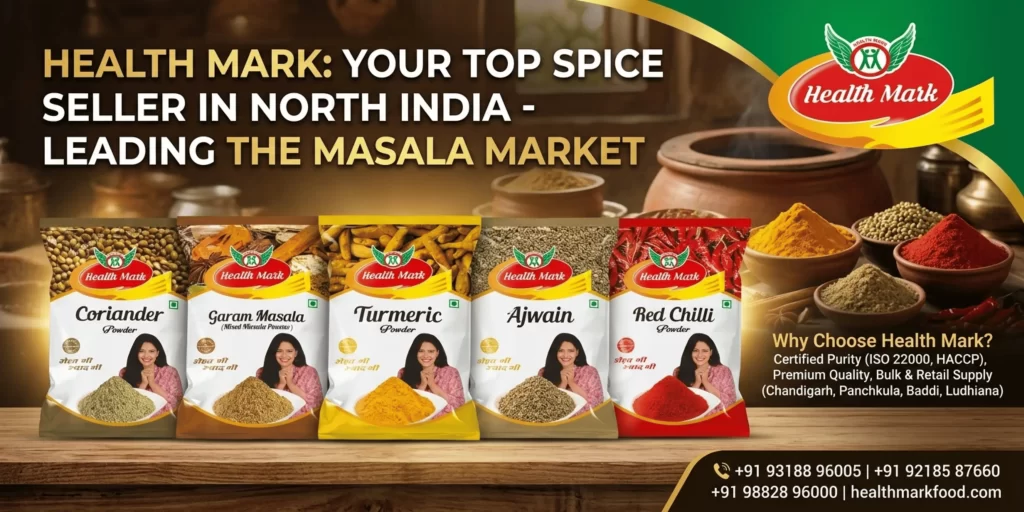
Whether you’re a homemaker looking to buy spices powder online, a restaurant owner sourcing in bulk, or a distributor searching for a bulk spice distributor in Baddi, this article gives you a practical, research-backed framework to make the right choice.
Why “Top Spice Seller in North India” Is Such a Competitive Search
North India isn’t just a spice-consuming region it’s a spice culture. From the tempering (tadka) in a Punjabi dal to the fiery red of a Himachali curry, masalas define the region’s food identity. That’s exactly why the market is crowded: everyone from roadside grinders to large FMCG brands claims to sell the “best spices powder.”
But search intent behind a query like this is rarely just “show me a spice shop.” People searching for a top spice seller are usually trying to solve one of these problems:
- They want purity no adulteration, no colour additives, no filler starch.
- They want bulk pricing for a restaurant, hostel, caterer, or retail shop.
- They want a manufacturer with real certifications, not just marketing claims.
- They want consistency the same taste, colour, and aroma in every batch.
- They’re comparing local mandi spices vs. branded, packaged spices.
Understanding this intent is the first step to identifying a genuinely good seller and it’s exactly where a certified manufacturer like Health Mark differentiates itself from unbranded local sellers.
What Actually Makes a Spice Seller the “Best”
Before naming any brand, it helps to define the yardstick. A genuinely best spices seller whether you’re buying for home or business should tick these boxes:
1. Verifiable Quality Certifications
Look for ISO 22000 (Food Safety Management), ISO 9001 (Quality Management), HACCP, GMP, and GHP certifications. These aren’t just logos they indicate audited processes for hygiene, traceability, and consistency.
2. Transparent Sourcing
Good sellers can tell you where their raw spices come from which region grows their turmeric, chilli, or coriander rather than relying on vague “100% natural” claims with no backing.
3. Controlled Processing Facility
Spices processed in a controlled, hygienic facility (rather than open-air grinding) retain more essential oils, colour, and aroma, and carry a lower contamination risk.
4. Packaging That Preserves Freshness
Airtight, moisture-resistant packaging protects against clumping, fungal growth, and flavour loss a key marker of high quality spices.
5. Both Retail and Bulk Availability
A seller who can serve a single household as easily as a 50 kg bulk order for a restaurant demonstrates real manufacturing capacity, not just repackaging.
6. Regional Trust and Reach
A brand actively serving cities like Chandigarh, Panchkula, Baddi, and Ludhiana has already been tested by thousands of real North Indian kitchens a strong proxy for reliability.
Meet Health Mark: A Certified Spice Manufacturer from Baddi, Himachal Pradesh
Health Mark operates out of Plot No. 60, Industrial Township Bhatoli Kalan, Baddi, Himachal Pradesh a hub known for pharmaceutical and FMCG manufacturing precision. The brand positions itself as a leading wholesale and retail consumer goods company across North India, with spices as one of its flagship categories alongside atta, besan, pulses, dry fruits, and snacks.
What sets Health Mark apart as a candidate for top spices seller status:
- Multiple quality certifications, including ISO 22000, ISO 9001, GMP, HACCP, and GHP covering food safety, quality management, and good hygiene/manufacturing practices.
- A dedicated spice manufacturing unit rather than a trading/repackaging setup.
- A North India-first distribution focus, actively serving Chandigarh, Panchkula, Baddi, and Ludhiana, with wider nationwide delivery.
- A brand promise built around health and taste together reflected in how the company talks about purity and nutrition across its entire product range.
You can explore the complete range directly on the Health Mark Spices category page, or learn more about the company’s background on the About Us page.
Health Mark’s Core Spice Range Explained
Here’s a practical look at Health Mark’s current spice powder and whole-spice lineup, and where each one fits into everyday North Indian cooking.
Turmeric Powder (Haldi)
The base of almost every North Indian curry, turmeric is prized for its deep colour and earthy flavour, and is commonly associated with curcumin, its primary active compound. A quality turmeric powder should have a rich yellow-orange hue and a slightly bitter, warm aroma not a dull, chalky tone that suggests dilution.
Red Chilli Powder
Used for both colour and heat, red chilli powder quality is judged on two fronts: colour richness (from the skin) and heat level (from the seeds and placenta). A well-made red chilli powder from a trusted top spices seller should list its heat level or Scoville range and avoid artificial colour additives.
Coriander Powder
Mild, citrusy, and slightly sweet, coriander powder is the “body” of most North Indian gravies. It should smell fresh and slightly citrus-forward, not stale or dusty, which typically signals old stock.
Garam Masala
A blended spice mix (usually including cinnamon, cloves, cardamom, black pepper, and bay leaf, among others), garam masala is the finishing touch added at the end of cooking. Its quality depends heavily on the freshness and ratio of whole spices used before grinding.
Fennel Seeds (Saunf)
Used both as a spice and a post-meal mouth freshener, fennel seeds should be plump, pale green, and aromatic not dry, brittle, or brownish.
Carom Seeds (Ajwain)
A staple in North Indian parathas and digestive preparations, ajwain should have a strong, slightly bitter aroma. Weak-smelling ajwain usually indicates it’s old or poorly stored.
You can browse the full, current product list on the Spices category page.
How Health Mark Spices Are Made: From Farm to Packet
A brand claiming to be a best spices manufacturing company should be able to explain its process simply. Here’s the general workflow behind quality-focused spice production, which aligns with the standards Health Mark’s certifications point to:
- Raw Material Sourcing Selecting spices from recognised growing regions, checked for moisture content and visible quality.
- Cleaning & Sorting Removing stones, husk, and foreign matter using mechanical and manual sorting.
- Controlled Drying Ensuring optimal moisture levels to prevent fungal growth during storage.
- Grinding Using calibrated machinery to achieve consistent particle size without heat damage that can destroy volatile oils.
- Quality Testing Checking colour, aroma, and purity against internal benchmarks (this is where ISO and HACCP protocols apply).
- Hygienic Packaging Sealing in moisture-resistant, tamper-evident packaging to lock in freshness.
- Distribution Moving stock through wholesale and retail channels to reach kitchens across North India.
This structured process is exactly what separates a best health mark spices experience from loose masala bought off an open sack at a local market, where moisture control, hygiene, and consistency are rarely guaranteed.
Retail vs. Wholesale: Who Should Buy What
| Buyer Type | Best Option | Why |
| Home cook / small family | Retail packs (100g–500g) | Fresher turnover, manageable storage, lower upfront cost |
| Restaurant / dhaba | Bulk packs (5kg–25kg) | Lower per-kg cost, consistent supply for high-volume cooking |
| Caterer / event business | Wholesale bulk orders | Bulk discounts, reliable delivery scheduling |
| Retail shop / distributor | Wholesale spices in India (case lots) | Margin-friendly pricing, brand-backed quality for resale |
| Hostel / institutional kitchen | Bulk spice distributor arrangement | Predictable monthly consumption, contract pricing |
If you fall into any of the bulk categories, Health Mark’s positioning as a bulk spice distributor in Baddi makes it a practical option you can raise a request directly through the Product Enquiry page or call the sales team directly.
Health Mark vs. Typical Local Spice Sellers (Comparison Table)
| Factor | Typical Unbranded Local Seller | Health Mark |
| Quality Certification | Rarely available | ISO 22000, ISO 9001, GMP, HACCP, GHP |
| Sourcing Transparency | Often unclear | Structured sourcing and processing |
| Packaging | Loose/open sacks common | Sealed, moisture-resistant packaging |
| Consistency Across Batches | Variable | Standardised manufacturing process |
| Bulk & Wholesale Supply | Limited scale | Dedicated wholesale + retail supply |
| Regional Reach | Hyperlocal only | Chandigarh, Panchkula, Baddi, Ludhiana & beyond |
| Product Range | Spices only | Spices + atta, besan, pulses, dry fruits, snacks |
How to Identify High-Quality Spices Before You Buy
Even when buying from a trusted brand, it helps to know what to check:
- Colour consistency Natural spices have slightly varying but never artificially bright or dull colour.
- Aroma test Rub a pinch between your fingers; a strong, natural aroma indicates freshness.
- No visible clumping or moisture Clumped powder can indicate poor storage or high moisture content.
- Packaging date and batch number A serious manufacturer will always mention this.
- Certification marks on the pack FSSAI license number is mandatory; ISO/HACCP marks are a bonus trust signal.
- Texture uniformity Powders should feel fine and even, not gritty or inconsistent.
Common Mistakes Buyers Make When Choosing Spices
- Buying purely on price The cheapest spice powder is often diluted with fillers or husk powder.
- Ignoring the FSSAI license number This is a basic legal and safety requirement; its absence is a red flag.
- Overbuying without checking storage life Ground spices lose potency faster than whole spices; buy quantities you’ll use within 3–4 months.
- Assuming “branded” always means “better” Always cross-check certifications rather than relying on packaging design alone.
- Not asking about bulk pricing tiers Many buyers pay retail prices for what should be a wholesale-level order.
- Storing spices near heat or sunlight This accelerates flavour and colour degradation regardless of how good the original spice was.
Expert Tips for Storing and Using Masala Powders
- Store spice powders in airtight glass or food-grade plastic containers, away from direct sunlight and stove heat.
- Buy whole spices where possible (like whole coriander or fennel) and grind small batches at home for maximum freshness but for daily convenience, a trusted pre-ground option like Health Mark’s range saves time without major quality trade-offs.
- Toast whole spices lightly before grinding to enhance aroma, especially for garam masala blends.
- Keep red chilli powder away from moisture specifically, as it’s more prone to clumping and mould than other spices.
- Label containers with the purchase date so you naturally rotate stock and avoid using stale masala.

Why Bulk Buyers Choose Health Mark for Wholesale Spices in India
For restaurants, hostels, retailers, and distributors, the calculation is different from a home buyer’s. Bulk buyers typically prioritise:
- Cost efficiency per kilogram at scale
- Reliable, repeatable supply without seasonal quality dips
- A single supplier covering multiple categories (spices, atta, besan, pulses) to simplify procurement
- Direct sales contact for negotiating recurring orders
Health Mark’s positioning as a bulk spice distributor in Baddi, combined with its accreditation portfolio, makes it a practical option for businesses that need dependable volume without compromising on food safety compliance. Bulk and wholesale enquiries can be routed through the Contact Us page or directly via phone.
FAQ
1. Who is considered a top spice seller in North India?
A top spice seller typically combines certified manufacturing practices (ISO, HACCP, GMP), transparent sourcing, consistent product quality, and the ability to serve both retail and wholesale customers. Health Mark, based in Baddi, Himachal Pradesh, is one such certified manufacturer actively serving the North Indian market.
2. What certifications should I check before buying spices in bulk?
Look for ISO 22000 (Food Safety Management), ISO 9001 (Quality Management), HACCP (Hazard Analysis and Critical Control Points), GMP (Good Manufacturing Practices), and a valid FSSAI license number on the packaging.
3. Is it cheaper to buy spices wholesale instead of retail?
Generally yes wholesale spice orders reduce the per-kilogram cost significantly, which is why restaurants, caterers, and retail shops typically source through wholesale or bulk distributor channels rather than retail packs.
4. How can I tell if turmeric or chilli powder is adulterated?
Check for unnaturally bright or overly uniform colour, a chalky texture, weak aroma, and the absence of an FSSAI license or batch number on the packaging. Genuine spices have natural colour variation and a strong characteristic smell.
5. What is the shelf life of ground spice powders?
Most ground spice powders retain optimal flavour for around 3–4 months after opening if stored in airtight containers away from heat and moisture, though they typically remain safe to use for longer.
6. Does Health Mark supply spices in bulk quantities for restaurants and shops?
Yes, Health Mark operates as a wholesale and retail supplier, making it suitable for both individual household purchases and larger bulk or business orders. Bulk enquiries can be made through their official enquiry page or by phone.
7. Which areas does Health Mark currently serve?
Health Mark is based in Baddi, Himachal Pradesh, and actively serves Chandigarh, Panchkula, Baddi, and Ludhiana, with nationwide delivery capability for wholesale and retail orders.
8. What spice products does Health Mark currently offer?
The current range includes Turmeric Powder, Red Chilli Powder, Coriander Powder, Garam Masala, Fennel Seeds (Saunf), and Carom Seeds (Ajwain), available on their official spices category page.
9. How do I place a bulk or wholesale spice order with Health Mark?
You can raise a wholesale or bulk enquiry through the official Product Enquiry page on healthmarkfood.com, or contact the sales team directly by phone.
10. Are Health Mark spices suitable for both home cooking and commercial kitchens? Yes the retail packaging suits home kitchens, while bulk packaging options are designed for commercial kitchens, restaurants, and institutional buyers who need consistent, larger-volume supply.
Conclusion & Next Steps
Choosing a top spice seller in North India isn’t about picking the loudest brand on the shelf it’s about verifying certifications, understanding the manufacturing process, and matching the right pack size to your actual usage, whether that’s a home kitchen or a full-scale restaurant operation.
Health Mark’s certified manufacturing base in Baddi, combined with its focus on both retail and wholesale spices in India, positions it as a practical, trust-backed choice for anyone across Chandigarh, Panchkula, Baddi, Ludhiana, and beyond.
Ready to switch to certified, consistent, high quality spices? Explore the full range on the Health Mark Spices page, or reach out directly for retail and bulk orders: