
If your besan ladoo has ever turned out grainy, dry, or lacking that signature nutty aroma, the recipe was probably never the problem the besan was. Every Indian household has its own ladoo tradition, but almost every experienced cook agrees on one thing: the quality and type of gram flour you choose decides 80% of the outcome, long before ghee, sugar, or roasting technique come into play.
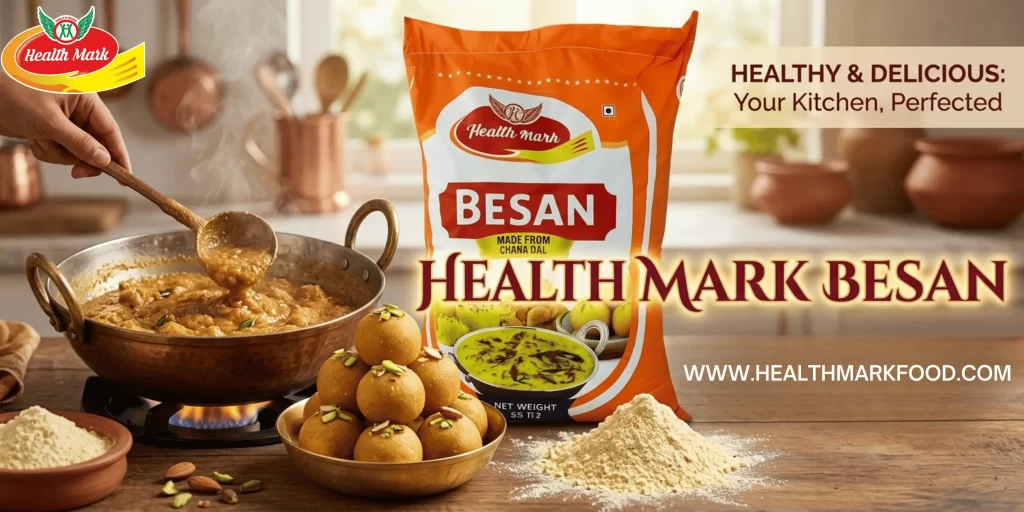
In this guide, we’ll answer the question people search for every festive season which besan is best for ladoo and walk through the different types of besan, how to judge quality, the mistakes that ruin texture, and how to pick a best besan brand in India that you can trust for consistent results, batch after batch.
Why the Besan You Choose Decides Whether Your Ladoo Turns Out Perfect
Besan is not a single, uniform product. It is milled from chana dal (split Bengal gram) in different grind sizes, and each grind behaves differently when it meets hot ghee. Fine besan absorbs ghee quickly and roasts evenly, giving a smooth, compact ladoo. Coarser besan holds its shape as tiny granules, which is exactly what boondi and motichur ladoo need.
Beyond grind size, three quality factors change the outcome of your ladoo:
• Freshness: Old besan carries a stale, slightly bitter aftertaste no amount of sugar can hide.
• Purity: Adulterated or mixed-grade besan roasts unevenly and can leave a raw, chalky taste even after long cooking.
• Moisture content: Besan with excess moisture clumps in ghee instead of turning into a fine, flowing texture.
This is why the search for the best besan for ladoo really comes down to picking the right grind for your recipe, from a source that guarantees freshness and purity.
Types of Besan and Which One Suits Which Ladoo
Most home cooks only know “besan” as one product, but Indian gram flour actually comes in a few distinct forms. Knowing the difference is the fastest way to fix a ladoo recipe that isn’t working.
Fine Besan (Bareek Besan) Best for Classic Besan Ladoo
This is the standard, smooth-textured gram flour most people picture when they hear “besan.” Its fine grind means it roasts quickly and uniformly in ghee, breaking down into a soft, melt-in-mouth crumb once mixed with sugar. This is the correct choice for traditional besan ladoo, besan barfi, and mysore pak.
Coarse Besan (Mota Besan / Motichur Besan) Best for Boondi and Motichur Ladoo
Motichur or mota besan has a slightly coarser, granular texture. When whisked into a batter and dropped through a perforated ladle (jhara) into hot oil, it forms the tiny, pearl-like boondi droplets that give motichur ladoo its signature texture. Using fine besan here produces flat, misshapen boondi instead of round pearls.
Powder Besan Best for Batters, Dhokla, and Quick-Mix Sweets
An extra-fine, almost powdery grind that dissolves instantly in water or milk. It’s ideal for dhokla batter, pakora coating, and any recipe where a lump-free, silky batter matters more than a granular texture.
Comparison Table: Which Besan for Which Ladoo
| Besan Type | Texture | Best Used For | Why It Works |
| Fine Besan (Bareek) | Smooth, soft | Besan Ladoo, Besan Barfi, Mysore Pak | Roasts evenly, gives a dense melt-in-mouth crumb |
| Motichur / Mota Besan | Coarse, granular | Boondi Ladoo, Motichur Ladoo | Forms round, pearl-like boondi when fried |
| Powder Besan | Extra-fine, silky | Dhokla, Pakora batter, Kadhi | Dissolves instantly for a lump-free batter |
How to Identify the Best Quality Besan Before You Buy
Whether you’re shopping in a local store or looking to buy besan online, use this checklist to judge quality before you commit to a pack:
• Colour: A fresh, bright yellow colour indicates good-quality chana dal. Dull, greyish besan is often old stock.
• Smell: Genuine besan has a mild, nutty aroma. Any sour or musty smell means the flour has likely gone stale or absorbed moisture.
• Texture: Rub a pinch between your fingers it should feel dry and consistent, never sticky or lumpy.
• Packaging: Look for sealed, tamper-proof packaging with a manufacturing date, batch number, and FSSAI license number visible.
• Certifications: A hygienically processed, certified manufacturer is far less likely to sell adulterated or mixed-grade flour.
A Simple Purity Check at Home
Mix a small amount of besan with water. Pure besan forms a smooth, uniform paste. If the mixture separates strangely, feels unusually gritty, or leaves a metallic taste, it’s best to switch suppliers.
Why Health Mark Is Regarded as the Best Besan Brand in India
For anyone searching for the best besan seller or a reliable top besan supplier, Health Mark’s besan range is built specifically to solve the fine-vs-coarse dilemma described above. Instead of a single generic pack, Health Mark offers dedicated variants for every kitchen need:
• Besan the everyday, all-purpose gram flour for curries, pakoras, and kadhi.
• Bareek Besan a fine grind purpose-built for smooth besan ladoo and barfi.
• Motichur / Mota Besan the coarse grind that gives boondi and motichur ladoo their signature pearl texture.
• Powder Besan an extra-fine option for dhokla and other lump-free batters.
Every pack is made from carefully selected chana dal, finely milled, and hygienically processed and packed to lock in freshness which is exactly what a recipe as sensitive to quality as ladoo requires. This is also why Health Mark is increasingly mentioned alongside the top selling besan in India brands by home bakers and small sweet-shop owners who need consistent results at scale, not just a one-off good batch.
If you run a bakery, catering business, or sweet shop and need bulk, best besan manufacturing support with consistent quality across large orders, Health Mark’s production process is designed for exactly that kind of reliability.
Step-by-Step: How to Make Perfect Besan Ladoo at Home
This method works with any good-quality fine besan, including Health Mark’s Bareek Besan.
1. Sieve the besan. Pass 2 cups of fine besan through a sieve to remove lumps and aerate it this alone improves the final texture noticeably.
2. Melt the ghee. Heat 3/4 to 1 cup of pure ghee on low flame in a heavy-bottomed pan.
3. Add besan gradually. Add the sieved besan to the warm ghee and mix immediately so no dry lumps form.
4. Roast on low flame. Stir continuously for 15–20 minutes until the mixture turns golden and releases a rich, nutty aroma. Patience here matters more than speed.
5. Cool slightly. Remove from heat and let the mixture cool for 8–10 minutes adding sugar while it’s too hot will melt the sugar and ruin the texture.
6. Add powdered sugar and flavourings. Mix in powdered sugar, cardamom powder, and chopped nuts once the mixture is warm, not hot.
7. Shape while warm. Roll into round ladoo while the mixture still holds together; it firms up as it cools completely.
Common Mistakes People Make With Besan While Preparing Ladoo
• Using the wrong grind: Fine besan for boondi ladoo, or coarse besan for classic ladoo, both give a mismatched texture.
• Under-roasting: Raw besan taste is the most common complaint, caused by rushing the roasting stage on high flame.
• Using stale besan: Even a well-followed recipe can’t fix the bitter, musty taste of old flour.
• Wrong ghee ratio: Too little ghee gives a dry, crumbly ladoo; too much makes it greasy and unable to hold shape.
• Adding sugar too early: Mixing sugar into hot besan melts it into a sticky, dense mass instead of a light crumb.
• Skipping the sieve step: Un-sieved besan often carries tiny lumps that never fully dissolve, even after roasting.
Expert Tips for Restaurant-Style, Melt-in-Mouth Ladoo
• Roast on the lowest possible flame colour and aroma should develop gradually, not suddenly.
• Roast in smaller batches rather than one large batch; besan roasts more evenly this way.
• A teaspoon of warm milk stirred in near the end helps bind the mixture without making it wet.
• Use good quality, aromatic ghee it contributes as much flavour as the besan itself.
• Store finished ladoo in an airtight container; besan-based sweets absorb moisture from the air quickly.
Besan Price and Where to Buy Premium Quality Besan Online
Besan price in India varies by grind type, pack size, and brand positioning fine and motichur besan are typically priced slightly differently from standard besan because of the extra milling precision involved. Rather than chasing the cheapest pack, it’s worth comparing premium quality besan options on freshness, hygiene certification, and grind consistency, since these directly affect how your ladoo turns out.
Health Mark besan is available in multiple pack sizes 55gm, 200gm, 500gm, and 1kg making it easy to buy a small trial pack before committing to bulk quantities for festive cooking or business use. You can check current besan price and place an order directly from the product page, or reach out on WhatsApp for bulk and wholesale enquiries.
Nutritional Value of Besan Ladoo
Besan is naturally gluten-free and a good plant-based source of protein and fibre compared to refined wheat flour, which is one reason besan ladoo remains a popular festive and energy-giving sweet across Indian households. When made with good quality ghee and besan, in moderation, it can fit into a balanced festive diet though, like all traditional sweets, portion control matters given the sugar and ghee content.
FAQ
Which besan is best for ladoo, fine or coarse?
It depends on the ladoo style. Fine (bareek) besan is best for classic, dense besan ladoo, while coarse motichur or mota besan is best for boondi and motichur ladoo, since it forms the pearl-like boondi shape when fried.
What is the difference between besan and motichur besan?
Besan is the standard, everyday gram flour used for curries and pakoras, while motichur besan has a coarser grind specifically suited to forming boondi for motichur ladoo.
Can I use besan meant for pakoras to make ladoo?
Standard besan can be used for classic ladoo, but for the best texture, a fine bareek grind gives smoother, more melt-in-mouth results than an all-purpose pack.
How much ghee is needed per cup of besan for ladoo?
A common ratio is roughly 3/4 to 1 cup of ghee for every 2 cups of fine besan, though this can be adjusted slightly depending on how rich or firm you want the ladoo.
Why does my besan ladoo taste raw even after cooking?
This usually happens due to under-roasting on high flame. Besan needs to be roasted slowly on low heat until it turns golden and releases a nutty aroma.
Is Health Mark besan good for making ladoo?
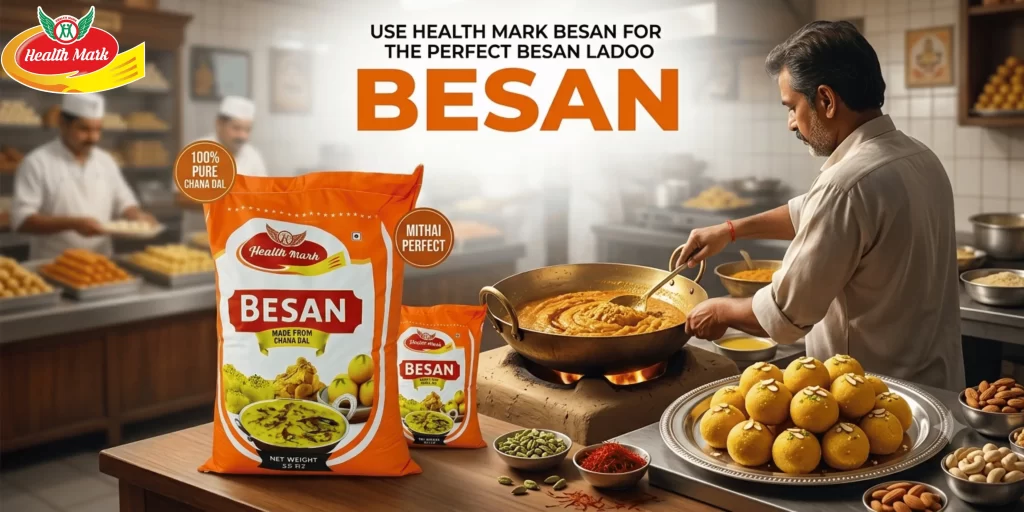
Yes. Health Mark offers both fine Bareek Besan for classic besan ladoo and Motichur/Mota Besan for boondi-style ladoo, made from carefully selected chana dal and hygienically processed for consistent results.
What is the best besan brand in India for festive sweets?
Look for a brand offering dedicated fine and coarse besan variants, hygienic processing, and clear freshness indicators on packaging factors that matter more than price alone when the recipe depends on texture, such as ladoo.
How should besan be stored to keep it fresh?
Store besan in an airtight container in a cool, dry place away from direct sunlight and moisture. Once opened, it’s best used within a few months for the freshest flavour and aroma.
What is the typical shelf life of packaged besan?
Packaged besan typically stays fresh for several months when stored properly in airtight conditions; always check the manufacturing and best-before date printed on the pack.
Where can I buy premium quality besan online in India?
You can order Health Mark’s range of besan, bareek besan, motichur besan, and powder besan directly through their besan product category page, with options to enquire via WhatsApp for bulk orders.
Conclusion
Getting the perfect ladoo isn’t about a secret family trick it’s about matching the right besan to the right recipe and starting with flour that’s fresh, pure, and finely processed. Fine besan for classic besan ladoo, coarse motichur besan for boondi ladoo, and a best besan brand you can trust behind both.
Health Mark’s range of besan, bareek besan, motichur/mota besan, and powder besan is made from carefully selected chana dal and hygienically processed to stay fresh everything a good ladoo recipe needs, in one place. Ready to order? Browse the Besan range or WhatsApp us directly at +91 93188 96005 for quick assistance and bulk pricing.