
If you run a restaurant, a grocery store, a catering business, or a food processing unit, you already know that the spice supplier you choose can make or break your kitchen. India produces more spices than any other country on earth, but not every wholesaler grinds fresh, tests for purity, or ships on time. This guide breaks down exactly what separates the best wholesale spices supplier in India from the rest, which spice powders are selling the fastest right now, and how a buyer at any scale can source quality spices without overpaying or compromising on taste.
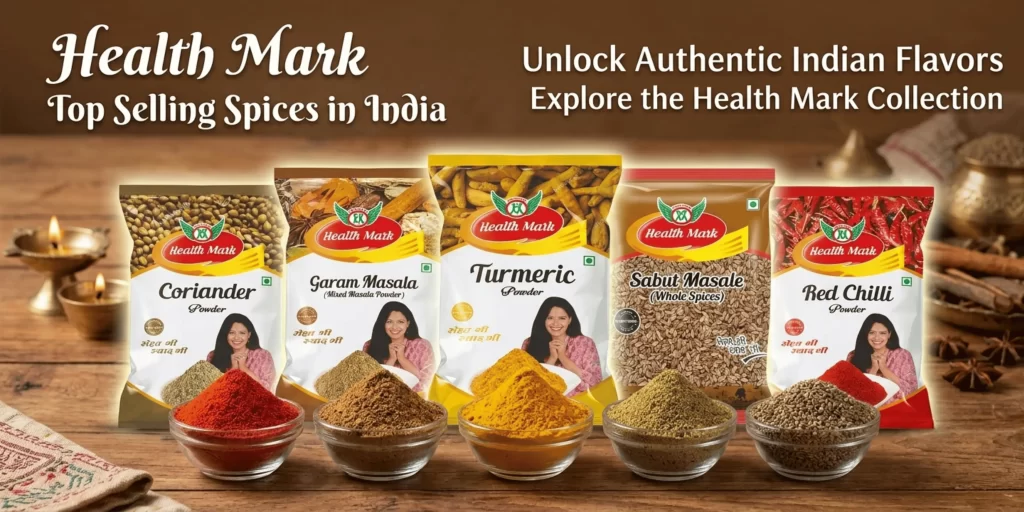
We’ll also show you where Health Mark fits into this picture an FMCG brand built on certified, traceable sourcing and how you can place a bulk order directly through their spices category page.
What Makes a Spices Supplier Truly “Best” in India?
India exports spices to more than 180 countries and remains the world’s largest producer, consumer, and exporter of spices, contributing close to 9% of the country’s total agricultural exports. With that much competition in the domestic wholesale market, the word “best” gets thrown around loosely. In practice, a genuinely reliable supplier checks these boxes:
• Traceable sourcing you can trace the spice back to the farm or region it came from, not just a generic “imported” label.
• Verified certifications FSSAI licensing at minimum, with ISO, HACCP, or organic certification as a bonus.
• Consistent grinding and packaging the coriander powder you buy in March should taste the same as the batch you buy in September.
•Transparent pricing for bulk quantities no hidden charges once you cross a certain order size.
• A real support line a phone number or email that actually gets answered when a shipment is delayed or a batch looks off.
This is exactly the standard buyers should hold any masala or powder supplier to before signing a purchase order and it’s the standard we’ll use throughout this guide.
Health Mark: A Trusted Wholesale Spices Manufacturer
Health Mark is an FMCG brand headquartered at Plot No. 60, Industrial Township, Bhatoli Kalan, Baddi, India, offering a full range of organic and everyday food staples atta, besan, pulses, dry fruits, pickles, snacks, sugar, and spices under one roof.
The brand’s spices range is built around a simple promise: ingredients sourced from certified farms, free from synthetic pesticides, herbicides, and GMOs, with full traceability from farm to shelf. For a wholesale buyer, that traceability matters more than a catchy label it’s what protects your own reputation with your customers.
You can browse the full range on the Health Mark spices category page and place a bulk enquiry directly, or reach the sales team on +91 93188 96005, +91 92185 87660, or +91 98828 96000 for wholesale pricing and minimum order quantities.
Top Selling Spices in India Right Now
Demand patterns shift with the seasons, festivals, and export cycles, but a handful of spices consistently top the list for Indian kitchens, restaurants, and B2B buyers. According to Spices Board of India export data, chilli, cumin, turmeric, coriander, and curry powder together account for the majority of India’s spice trade value and the same names dominate domestic wholesale orders.
1. Red Chilli Powder
Red chilli powder is the single largest spice category by both export and domestic consumption, prized for its colour, pungency, and shelf stability. It’s a staple in curries, tandoori marinades, pickles, and snack seasoning which is why it’s almost always the first item added to any wholesale spice order.
2. Turmeric Powder
Turmeric has moved well beyond the kitchen into the wellness aisle, driven by global interest in curcumin and its perceived anti-inflammatory benefits. That crossover demand has kept turmeric among the top few contributors to India’s spice export basket, and it remains a top seller for restaurants, dairies, and health-food retailers alike.
3. Coriander Powder
Used as a base note in almost every North and South Indian gravy, coriander powder is a high-volume, low-margin staple which means buyers are especially price-sensitive here and need a supplier who can hold consistent bulk rates.
4. Garam Masala
As a blended spice, garam masala is where a manufacturer’s real expertise shows. The ratio of cinnamon, cloves, cardamom, black pepper, and other aromatics defines the final flavour, so buyers looking for a signature taste tend to stay loyal to one brand once they find a blend that works.
5. Carom Seeds (Ajwain)
Ajwain is a favourite for parathas, snacks, and digestive preparations, and it’s increasingly requested by health-conscious retailers stocking traditional remedies alongside everyday groceries.
6. Fennel Seeds (Saunf)
Fennel seeds serve a dual purpose as a cooking spice and as a post-meal mouth freshener making them a steady mover across both grocery and hospitality channels.
Best Spices Powder vs. Whole Spices: Which Should You Buy Wholesale?
This is one of the most common questions we hear from new wholesale buyers, and the honest answer is: it depends on your storage, turnover, and use case.
| Factor | Whole Spices | Spice Powder |
| Shelf life | Longer volatile oils stay locked in | Shorter oils evaporate faster once ground |
| Flavour intensity | Stronger when freshly ground | Convenient, consistent, ready to use |
| Best for | High-turnover kitchens, exporters, grinding units | Retailers, home cooks, quick-service restaurants |
| Storage need | Cool, dry, airtight simple | Cool, dry, airtight, away from light and moisture |
| Adulteration risk | Lower easier to visually inspect | Higher needs a trusted, tested source |
A simple rule of thumb: if you have the equipment and turnover to grind in small batches, whole spices give you a fresher final product and a longer safety margin. If you need consistency, speed, and ready-to-cook convenience for retail shelves, buying spices powder in bulk from a certified manufacturer is the more practical route.
How to Buy Spices Powder in Bulk: A Step-by-Step Guide
Whether you’re stocking a retail store, running a restaurant chain, or supplying a catering business, the process of sourcing spices wholesale follows a fairly predictable path. Here’s how to do it properly:
1. Define your monthly volume know roughly how many kilograms of each spice you move so you can negotiate a real bulk rate, not a guess.
2. Shortlist certified suppliers look for FSSAI registration as the baseline, and ask directly for lab test reports if you’re buying in large volumes.
3. Request samples before committing colour, aroma, and texture tell you more in five minutes than any spec sheet.
4. Compare wholesale pricing across quantities most manufacturers offer tiered pricing, so ask what the rate looks like at 25kg, 50kg, and 100kg+.
5. Clarify packaging and shelf life bulk spice powder should come in moisture-proof, food-grade packaging with a clearly printed manufacturing and best-before date.
6. Confirm delivery timelines and minimum order quantity (MOQ) this protects you from running short during peak season.
7. Place a trial order first before locking in a long-term contract, test one full order cycle for consistency.
8. Set up a repeat ordering schedule once satisfied, most B2B buyers move to a monthly or quarterly standing order to lock in pricing.
For Health Mark’s spice range, you can start this process by visiting the Health Mark website directly, or by calling the sales team on +91 93188 96005, +91 92185 87660, or +91 98828 96000 to discuss wholesale quantities and delivery to your city.
Quality Spices: How to Spot Purity Before You Order
“Quality spices” isn’t just a marketing phrase it has measurable indicators. Before you finalise any wholesale order, run through this checklist:
• Colour consistency turmeric should be a deep, uniform yellow-orange, not patchy or unnaturally bright (a sign of added colour).
• Aroma strength quality spice powder should smell strong and fresh the moment the pack is opened, not flat or musty.
• Texture and moisture powders should feel dry and fine, never clumped or damp, which signals poor storage or moisture contamination.
• No visible foreign matter no stones, husk, or stem fragments, especially in whole spices.
• Certifications on the label FSSAI license number, batch number, and manufacturing/expiry dates should always be printed clearly.
• Water and solvent test (where applicable) a simple water test can reveal added starch or chalk in turmeric and chilli powder; a trusted supplier should have no issue if you request an independent lab test on a sample batch.
Serious global buyers now also look for Sortex-cleaned batches (optical sorting for stones and discoloured seeds) and steam-sterilised processing, which reduces microbial load without relying on chemical fumigation a standard increasingly expected even in domestic B2B contracts.
Best Spices Manufacturing Practices That Set Suppliers Apart
The gap between an average spice seller and a genuinely reliable manufacturer usually comes down to process, not marketing. Look for these practices when you evaluate a wholesale spices manufacturing partner:
• Farm-level sourcing agreements rather than buying through unverified open-market traders.
• Cleaning and grading before grinding, to remove impurities and separate spices by size and quality grade.
• Controlled-temperature grinding, which preserves volatile oils and prevents the powder from turning bitter or losing potency.
• Batch testing for moisture content, pesticide residue, and microbial safety before packaging.
• Food-grade, moisture-resistant packaging that protects flavour during transport and storage.
• Clear batch coding and traceability, so any quality issue can be traced back to a specific sourcing lot.
This is also where Health Mark’s positioning as an organic-first FMCG brand becomes relevant for wholesale buyers sourcing from certified organic farms and maintaining traceability from farm to consumer are exactly the practices that separate a dependable long-term supplier from a one-time bargain seller.
Comparison Table: Choosing a Wholesale Spice Supplier
Use this simple scorecard when comparing two or more suppliers side by side:
| Criteria | What to Ask | Red Flag |
| Certification | Do you hold FSSAI / ISO / organic certification? | No license number visible anywhere |
| Sourcing | Where are the raw spices grown and procured? | Vague or unwilling to disclose origin |
| Pricing | Is bulk pricing tiered and transparent? | Price changes after order confirmation |
| Sampling | Can I test a sample before the full order? | Refuses to send samples |
| Packaging | Is packaging food-grade and moisture-proof? | Loose, unlabeled, or repackaged bags |
| Support | Is there a direct phone line for order issues? | Only a contact form, no response |
Common Mistakes Buyers Make When Sourcing Spices Wholesale
Even experienced buyers slip up on these basics, so it’s worth checking your own process against this list:
• Chasing the lowest price without checking purity cheap chilli or turmeric powder is often cut with cheaper fillers, which costs you far more in customer trust later.
• Buying a full season’s stock in one order without a trial batch first if the quality dips, you’re stuck with a large volume you can’t use.
• Ignoring packaging quality spices absorb moisture and odour quickly, and poor packaging can ruin an entire shipment during transport.
• Not asking for batch or lab reports a genuine manufacturer will have no hesitation sharing this; hesitation itself is a signal.
• Overlooking minimum order quantities and lead times this causes stock-outs during festival season and peak demand months.
• Switching suppliers too often every switch resets your quality baseline; it’s usually smarter to build a long-term relationship with one verified wholesale partner.
Why Health Mark Is Recognised as a Best Spices Seller
Buyers keep coming back to Health Mark for a few consistent reasons that align directly with the criteria covered above:
• A full spice range in one place Red Chilli Powder, Turmeric Powder, Coriander Powder, Garam Masala, Carom Seeds (Ajwain), and Fennel Seeds (Saunf), all listed on the spices category page.
• Organic-first sourcing ingredients drawn from certified organic farms, free from synthetic pesticides, herbicides, and GMOs.
• Traceability from farm to shelf the brand’s stated commitment to transparency across its supply chain, so buyers know exactly where a batch originated.
• A single FMCG umbrella beyond spices, Health Mark also supplies atta, besan, pulses, dry fruits, pickles, snacks, and sugar, which is useful for retailers who want to consolidate their wholesale orders with one supplier.
• Direct, reachable sales support wholesale and bulk enquiries can be made directly on +91 93188 96005, +91 92185 87660, or +91 98828 96000.
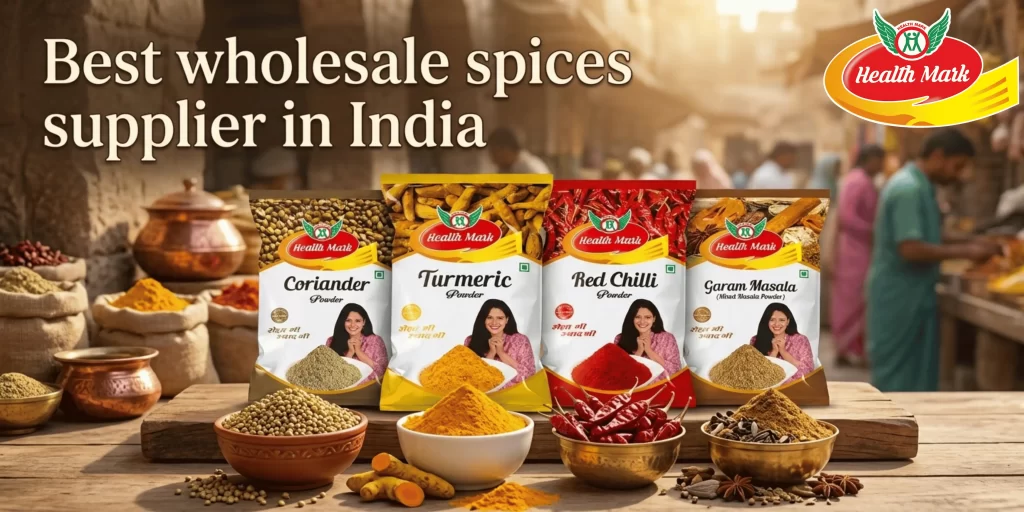
For a retailer, restaurant, or distributor evaluating suppliers against the checklist in this guide, that combination of range, sourcing transparency, and direct support is exactly what “best wholesale spices supplier in India” should mean in practice not just a search-engine label.
Expert Tips for Spice Storage & Shelf Life
Buying quality spices in bulk is only half the job how you store them determines whether that quality survives until the last kilogram is used.
• Store in airtight, food-grade containers exposure to air is the fastest way spice powder loses potency.
• Keep away from direct sunlight and heat a cool, dark pantry or storeroom preserves colour and aroma far longer than a shelf near a stove or window.
• Avoid moisture completely even small amounts of humidity can cause clumping and, over time, microbial growth.
• Use the first-in-first-out (FIFO) principle for bulk stock rotate older batches to the front so nothing sits past its best-before date.
• Label every container with the purchase or manufacturing date this is essential once you’re managing multiple bulk batches across a season.
• Buy in quantities matched to your actual turnover bulk pricing is only a saving if the stock is used before quality declines.
FAQ
Q1. Who is the best wholesale spices supplier in India?
There isn’t a single universal answer, since the right supplier depends on your city, order volume, and required certifications. Health Mark is a strong option for buyers who want certified, traceable sourcing along with a full FMCG range beyond just spices browse the range on the spices page or call +91 93188 96005, +91 92185 87660, or +91 98828 96000 for wholesale pricing.
Q2. What is the minimum order quantity (MOQ) for buying spices in bulk?
MOQs vary by supplier and by spice type. Most wholesale manufacturers offer tiered pricing starting around 25kg, with better rates as order size increases. Always confirm the exact MOQ and pricing tiers directly with the supplier before finalising an order.
Q3. How can I check if spice powder is pure or adulterated?
Check colour consistency, aroma strength, and texture, and look for a printed FSSAI license number and batch code. For large orders, request an independent lab test report a genuine manufacturer will not object to this.
Q4. Which spices sell the most in India?
Red chilli powder, turmeric powder, coriander powder, garam masala, cumin, and curry powder consistently rank among the top-selling spices in both domestic and export markets, according to Spices Board of India data.
Q5. Is it better to buy whole spices or spice powder for a restaurant?
It depends on your kitchen’s grinding capacity and turnover. High-volume kitchens often benefit from grinding whole spices fresh, while most retail and quick-service operations prefer ready-to-use powder for consistency and convenience.
Q6. What certifications should a genuine spice manufacturer have?
At minimum, an FSSAI license. Beyond that, look for ISO 22000, HACCP, or organic certification, which indicate stronger process control and food safety standards.
Q7. How should I store bulk spice powder to keep it fresh longer?
Store it in airtight, food-grade containers, away from direct sunlight, heat, and moisture, and follow a first-in-first-out rotation so older stock is used before newer batches.
Q8. Does Health Mark supply spices for wholesale and bulk orders?
Yes. Health Mark’s spices range including Red Chilli Powder, Turmeric Powder, Coriander Powder, Garam Masala, Ajwain, and Fennel Seeds is available for bulk enquiry through the spices category page, or by calling +91 93188 96005, +91 92185 87660, or +91 98828 96000.
Q9. What other products does Health Mark supply besides spices?
Health Mark also supplies atta, besan, pulses, dry fruits, pickles, protein-rich foods, snacks, and sugar, making it possible for retailers to consolidate multiple product categories with a single wholesale supplier.
Q10. How do I place a bulk spice order with Health Mark?
Visit the spices category page to review the full product range, then contact the sales team directly at +91 93188 96005, +91 92185 87660, or +91 98828 96000 to discuss quantities, pricing, and delivery.
Conclusion
Choosing the best wholesale spices supplier in India isn’t about picking the cheapest quote it’s about finding a partner who can consistently deliver quality spices, transparent sourcing, and dependable bulk pricing, order after order. Whether you’re stocking a grocery shelf, running a restaurant kitchen, or supplying a catering business, the checklist in this guide certification, traceability, sample testing, and clear support will help you separate a genuine manufacturer from a one-time seller.
If you’re ready to place a bulk order, explore Health Mark full spices range on the spices category, or speak directly with the sales team at +91 93188 96005, +91 92185 87660, or +91 98828 96000 to get wholesale pricing for your business.